
Module 8 Tibb Principle: Lifestyle Factors
Learning outcomes:
- Lifestyle Factors influence humours by the qualitative effect they exert on an individual.
- Understanding that Tibb Lifestyle Factors are ultimately the cause of both health and disease.
- Appreciation that well managed Lifestyle Factors promote health, and if poorly managed will lead to disease.
In this video, Prof. Bhikha provides a detailed explanation of the best way to maintain homeostasis by effectively managing the Six Lifestyle Factors in Tibb.
Introduction

The Tibb principle of ‘temperament’ highlights that each individual has a temperamental combination of a dominant and sub-dominant temperament with an overall qualitative state having one dominant quality, less of the two adjacent qualities and the least amount of an opposite quality.An individual with a dominant sanguinous and sub- dominant phlegmatic temperament (X) will have an overall dominant quality of moistness followed by heat, less of coldness and the least amount of dryness – an increase of the dominant quality will negatively affect this individual to the greatest extent.
Whilst the overall qualitative state of an individual’s temperament is fixed, the overall qualitative state of the humours is constantly changing from the influence of the lifestyle factors, especially food & drink from which the humours are produced.Lifestyle factors influence humours by the qualities they possess and therefore exert – for example, certain foods such as ginger have heating properties and would therefore increase heat within the body, exercise also increases heat, sleep has a cooling effect and emotions such as grief would increase cold and dryness. Whilst physis is responsible to restore balance to the qualities of the humours to the same as the overall qualities of the temperamental combination, this is not possible if lifestyle factors are not effectively managed. Lifestyle factors are ultimately the cause of both health and disease.
An important rule to remember in the implementation of Lifestyle Factors is:
An increase in the dominant quality associated with an individual’s temperamental combination from Lifestyle Factors, will have a negative effect.
The Six Lifestyle Factors of Tibb
Tibb has identified Six Lifestyle Factors, all of which are associated with the four qualities of heat, coldness, moistness, and dryness and can either benefit or be harmful to an individual. These include:
- Environmental Air & Breathing: e.g. the weather is either Hot/Cold/Dry/Moist
- Food & Drink: e.g. ginger is heating, cucumber is cooling)
- Movement & Rest: e.g. exercise increases heat
- Sleep & Wakefulness: e.g. sleep is cooling, wakefulness is drying
- Emotions and Feelings: e.g. anger increases heat
- Elimination: e.g. vomiting/diarrhoea causes dehydration leading to drynessListed below is a brief summary of each of the Six Lifestyle Factors.
Environmental Air & Breathing
Environmental air refers not only to the air that all living organisms share, but also the effect of seasons and weather patterns. One should always be aware of the seasonal changes and the adverse effects that exposure to extreme climatic changes have. During cold and wet climatic conditions, those with a phlegmatic temperament should take special care to ensure that optimum body heat is maintained. Similarly, a bilious person should avoid too much exposure to summer heat.With respect to temperamental combinations, a person with a dominant sanguinous and sub-dominant phlegmatic temperament, having a dominant quality of moistness, will be most uncomfortable and negatively affected in weather conditions where excessive moistness is prevalent. An individual with a dominant melancholic and sub-dominant bilious temperament will be negatively affected during the dry season of autumn.
The air we breathe, is our primary source of nutrition, vital to our health. Tibb advocates correct breathing techniques and encourages breathing exercises and meditation.
Food & Drink
Of all the lifestyle factors, food and drink is the easiest to implement since it is entirely in our control.
In addition, as humours are produced from one’s diet, this lifestyle factor is the most important. Each food type can be classified as being heating or cooling with levels of moistness or dryness – where heating foods increase the metabolic rate and cooling foods decrease the metabolic rate. This classification refers to the inherent temperament or quality associated with the foods and the effect they have – milk has qualities of cold and moist, while chicken is hot and dry.Similar to temperament and humours, foods are also classified according to the four groups: Hot & Dry; Hot & Moist, Cold & Dry and Cold & Moist foods. Each of these categories are subdivided into Meats, Vegetables, Fruits, Nuts, Grains & Seeds, Dairy Products, Herbs & Spices, Drinks, Flavourants, Confectionary & Desserts, Cereals, Dishes.Diet charts are therefore used to determine which foods are best for an individual based on their specific temperamental combination.
Identifying diet charts for different temperaments
When identifying which diet charts will be appropriate for the different temperamental combinations, it needs to be remembered that foods with the same qualities as the dominant quality associated with an individual’s temperament will negatively influence health. It therefore implies that foods from the opposite spectrum of the temperamental chart will be most appropriate for the maintenance of good health.
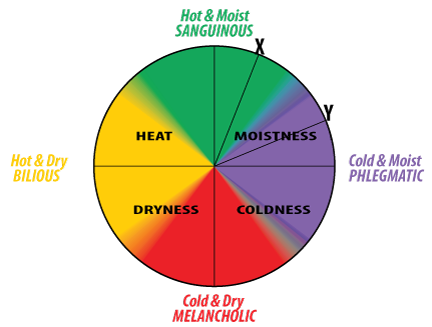
For example, an individual with a dominant Sanguinous sub- dominant Phlegmatic temperament – marked X should eat mostly Cold & Dry foods, followed by Hot & Dry foods, less of Cold & Moist foods, and the least amount of Hot & Moist foods. Similarly, an individual with dominant phlegmatic sub-dominant sanguinous temperament (marked Y), should eat mostly Hot & Dry foods, followed by Cold & Dry, less of Hot & Moist and the least amount of Cold & Moist.
Although the foods have been classified according to the four categories mentioned above, most food ingredients are included in different recipes. The overall quality of a recipe is determined through taste:
- Salty taste – Hot & Moist,
- Pungent taste – Hot & Dry,
- Bitter taste – Dry & Hot,
- Sweet taste – Moist & Hot,
- Sour taste – Cold & Dry,
- Tasteless/Insipid taste – Cold & Moist.
Therefore, an individual with a dominant bilious and sub-dominant sanguinous temperamental combination should avoid pungent tasting (Hot & Dry) foods and also to a lesser extent salty tasting (Hot & Moist) foods to reduce the heat associated with this temperamental combination. The recipes beneficial for a dominant melancholic and sub- dominant bilious temperamental combination should have salty tasting (Hot & Moist) foods and tasteless (Cold & Moist) foods to maintain good health and well-being.
Movement & Rest
Controlled, regular and suitable physical exercise is an important aspect of maintaining good health. Tibb believes that equal attention should be given to the role of exercise and rest. As we are all unique, we each have different requirements for exercise and rest.
It is of the utmost importance to do exercises that are appropriate for an individual’s temperament. Some temperaments are more suited to strenuous exercises than others.
The scenario listed below is a typical example of making the right choice of exercising.
“A couple joins a health club. They both participate in spinning classes (excessive cycling at a heavy pace, for at least 45 minutes). The husband – sanguinous/phlegmatic (dominant quality of moistness), had adequate moisture to balance the increased heat level. On the other hand, his wife (bilious/melancholic) developed an overactive thyroid due to an increase in heat & dryness from the exercise.”
Also, the attitude to movement/exercise differs in different temperaments, for example, the bilious temperamental type prefers competitive activities whereas a phlegmatic individual prefers leisurely walks or gardening.
From the above it is obvious that choice of exercise has to be according to the temperament of an individual. Whilst swimming, walking or pilates is best for all temperamental types, high impact exercises such as jogging is not ideal for the typical melancholic thin/bony frame.
Sleep & Wakefulness
The quality and amount of sleep is essential for restoring harmony in the body. Tibb considers sleep to be cooling and moistening. Wakefulness increases dryness and heat and depletes energy due to physical and mental activity. Sound and peaceful sleep allows physis an uninterrupted opportunity to restore harmony in the body, repair and heal damage done, strengthen the body’s natural functions and eliminate toxins.
Everyone has a need for sleep, but the hours required differs from person-to-person. The sleep requirements for the different temperamental types are:
- Bilious: 5 to 6 hours minimum per night
- Melancholic: 6 to 7 hours minimum per night
- Sanguinous: 6 to 8 hours minimum per night
- Phlegmatic: 8 hours per night
Emotions & Feelings
Our emotions play a vital role in our well-being. Every emotion has a different qualitative effect on the body. Positive emotions, such as happiness, optimism, love, and humour are known to invigorate the body. Negative emotions such as anxiety, frustration, resentment, and anger can cause serious health problems.
Tibb associates each emotion with a qualitative effect – anger is Hot & Dry, worry is Hot & Moist, depression is Moist & Hot, fear is Cold & Moist, grief is Cold & Dry, and excitement is Dry & Hot.Individuals are more prone to the emotions that have the same qualities as their temperament. A dominant melancholic (Cold & Dry) will be more prone to experience grief, whereas a dominant bilious (Hot & Dry) is prone to anger. This link of predisposition to emotions needs to be managed to avoid negative effects on the individual – the bilious dominant individual needs to be find effective ways of avoiding anger with meditation and breathing exercises.
Elimination
Undigested food and poor elimination puts strain on the body and causes an accumulation of toxins. Optimising efficient digestion and elimination may involve dietary changes, detoxification and fasting.
The body take what it needs for energy and survival from the environment and expels what it does not need back into the environment in the form of waste products. When the body is not able to efficiently remove waste products it is susceptible to many different disease conditions. Waste products are removed from the body through bowel movements, sweating and urinating.
Of all the normal elimination methods, elimination from the colon requires special attention. Most of the re-absorption of water from the digestive tract takes place in the colon. Due to the osmotic pressure created from the re-absorption process, a film of matter accumulates on the sides of the colon. Normal peristaltic movement does not remove this accumulation which becomes a reservoir of toxic matter. Although one may eliminate regularly, this build up can only be removed with an appropriate laxative taken on a regular basis. This helps the body to keep the colon free of toxic waste and is an important step to health maintenance.
Relationship between Physis, Temperament, Humours and Lifestyle Factors
The scheme below illustrates the constant interplay between temperament, humours, lifestyle factors and physis. Although an individual’s temperament is fixed, humours fluctuate constantly as a result of changes to diet and other aspects of lifestyle, such as sleep, physical activity, breathing efficiency and stress levels. This dynamic relationship influences the humoral balance qualitatively, in relation to the ideal qualitative state required by an individual’s temperament. Physis is then constantly striving to restore homeostasis. The inability of physis to restore homeostasis inevitably leads to pathological processes that manifest as clinical disorders.

From the above, it is evident that Lifestyle Factors are ultimately the cause of both health and if not well managed will lead to disease.
The Tibb principle of the qualitative effect of Lifestyle Factors on humours in relation to an individual’s temperament, thus working with physis in health promotion and illness management, is unique to the Tibb philosophy.
References
- Bhikha, R. (2006). 4 Temperaments 6 Lifestyle Factors. Ibn Sina Institute of Tibb, South Africa.
- Jabin, F. (2011). A Guiding Tool in Unani Tibb for Maintenance and Preservation of Health: A Review Study. Afr J Tradit Complement Altern Med., 140-143. https://pubmed.ncbi.nlm.nih.gov/22754067/
- Choopani, R., Emtiazy, M. (2015). The Concept of Lifestyle Factors, Based on the Teaching of Avicenna (Ibn Sina). International Journal of Preventative Medicine. https://www.ncbi.nlm.nih.gov/pmc/articles/PMC4410439/